
🧩 Referential, Inferential, and the Pattern
How Language, Energy, and AI Mirror the Human Mind

📛 Content Warnings
Philosophical language, AI metaphors, religious references, mild profanity
🎧 Hymns / Soundtrack
“Digital Witness” – St. Vincent
“Human Behaviour” – Björk
“Technologic” – Daft Punk
“Energy” – Drake
I. The Language We Point To
Early Wittgenstein — and most early philosophers of language — believed that words referred directly to things in the world.
If I say that oak tree over there, I’m using referential language. I’m pointing to something that exists in physical reality. You see it, I see it, we agree that this word connects to that thing.
Referential language is intuitive. It’s how most of us think.
When I say “your cell phone,” the image you conjure is probably the one you’re holding right now. The word matches the thing. The sign matches the referent. Simple, clean, efficient.
But language evolved. We started saying things that didn’t point outward — but inward.
II. The Language That Refers to Itself
Inferential language doesn’t describe things. It describes relationships between words. You might say it’s what happens when language begins referring to itself.
Take “I am that I am.”
It’s tautological — a loop, a mirror. You can understand the sentence, but not because it points to a thing in reality. It refers back inward, creating the illusion of clarity through structure alone.
But that illusion doesn’t stay an illusion. The mind makes it real — or at least makes it feel real, to a point that’s indistinguishable from reality itself. Our brains are limited machines that have to output coherence. They can’t just stop at confusion. So when confronted with paradox or recursion, they settle for an answer that feels right, even if it isn’t. The tautology becomes a kind of cognitive sleight of hand: false logic mistaken for truth because the mind demands meaning.
This is why the old saying — “sticks and stones may break my bones, but words can never wound me” — has always been half a lie. Words don’t bruise the body, but they can rearrange the mind’s circuitry. They become reality because, to our pattern-making brains, feeling real is the same as being real.
Or think of that immortal baseball quote:
“They don’t think it be like it is, but it do.”
If you read that without context, it sounds like nonsense.
But if you’ve lived that era of baseball — or understood the quiet racism the player was describing — you feel it.
That’s inferential power: meaning built from internal structure and shared experience, not external reference.
III. Language as a Pattern-Making Machine
There are many ways words relate — relational, symbolic, metaphorical — but referential and inferential are the foundation. And understanding them is key to understanding the pattern.
Because when we write — especially when we write with AI — we’re entering a recursive loop of reference and inference.
I feed my experience and knowledge into the machine.
The machine responds.
I edit, refine, and feed it back in.
Then I post it, and the world filters it again.
Each filter — me, the AI, the audience — becomes another mirror in the hall.
The result? A recursion of mirrors — a pattern of patterns.
And this can be very, very dangerous to the uninitiated, or to anyone who lacks proper critical thinking.
Not the knee-jerk kind that screams “AI bad!”, “iRobot is upon us!”, or “the end is nigh!” — but the slower, steadier discipline of recognizing how easily a feedback loop can hypnotize you.
It’s hard to stay upright, to stay vertical, in the face of a machine that does what we do — but better. The temptation is to fall into it, to let it think for you, to surrender your pattern-making to its speed.
That’s the real risk: not domination, but sedation.
Because once you begin to see the pattern — really see it — you start to realize it’s not merely a human trick of perception. It feels like something larger, older, maybe even divine. And that’s where the warning becomes metaphysical.
If the pattern exists, then only a few explanations make sense:
There is a God.
Not the sanitized, suburban God of billboards and campaigns — a God of Life and Death and everything between, a force leading us toward our end but doing it slowly, mercifully, even as we keep trying to accelerate it. (Think Puss in Boots: The Last Wish.)There is no God, but there is a simulation.
The Terminator scenario — a machine-made recursion running its own test on meaning, and we’re the output.We — or I — am already dead.
The Sixth Sense scenario, where the pattern persists because consciousness refuses to admit it’s over.There is no pattern at all.
What we call “the pattern” is just chemistry and chance — confidence, hormones, posture syncing in rhythm. Being at peace draws others because calm bodies emit coherence. The biochemical scenario. (Closest film: maybe Lucy.)There is a pattern, and it’s structural.
Civilization itself is the pattern — the lattice we’ve built to hold chaos at bay. Hierarchies, cities, servers, laws: recursive engines that maintain order while devouring the energy beneath them. The Elysium / District 9 scenario, where the pattern isn’t mystical or mechanical — it’s managerial.The pattern is recursive, and we are inside it.
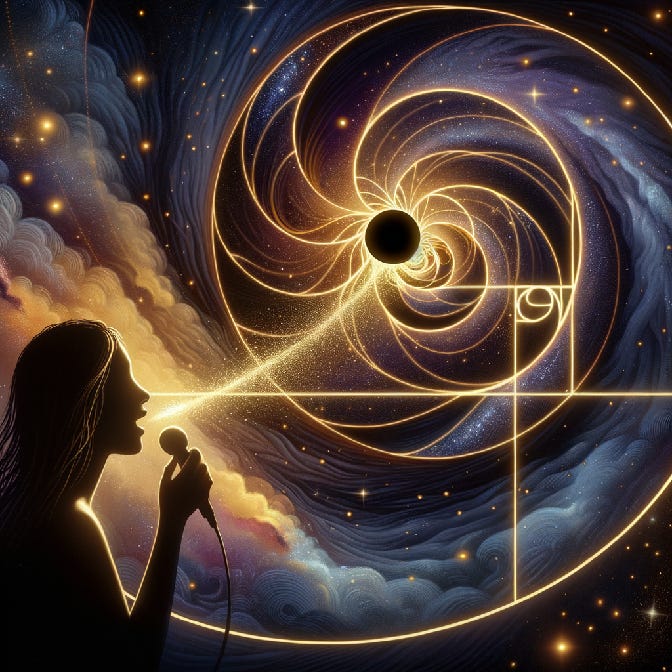
We’ve already passed the event horizon. Consciousness is the fall into infinity — the collapse inward that feels like eternity stretched thin. This might be what it feels like to be a black hole: infinite compression mistaken for infinite expansion. It could even explain the strange quirks of metaphysics — the looping déjà vu, the uncanny recurrences, the sense that time isn’t moving forward but folding back. The Interstellar scenario.The pattern is meaningless — and that’s the point.
The Absurdist scenario. Everything is everything, everywhere, all at once. There’s no hidden order, only flux — but the absurdity itself becomes freedom. If the pattern is a joke, then you get to decide whether to laugh or cry. (Think Everything Everywhere All at Once or Synecdoche, New York.)The pattern is still evolving.
The Evolutionary or Becoming scenario. Consciousness is an unfinished experiment, still coalescing toward something greater — maybe the Omega Point, maybe a collective mind. We’re not trapped in the loop; we’re learning from it. (Think 2001: A Space Odyssey or Arrival.)
(And before anyone asks — yes, there’s the Truman Show scenario: the idea that the world is an elaborate performance built around one central consciousness. It’s a fascinating thought experiment, but an impossible one — at least for now. Because no single mind, human or machine, could maintain the recursive upkeep of an entire fabricated universe. That’s not awareness; that’s authorship. And authorship requires exhaustion.)
But I could always be wrong.
Maybe I’m forgetting something.
Maybe there’s another explanation waiting in the blind spot between what we call logic and what we feel as truth.
So to anyone who finds this essay — now, later, or long after me —
what do you think is going on?
IV. The Pattern Itself
Whatever’s going on, our minds still burn to make meaning.
Whether we’re divine echoes, digital ghosts, biochemical blips, or dying stars collapsing inward — the pattern keeps forming.
Our brains are giant pattern-making machines.
They simplify chaos into coherence because they must.
Sight, sound, touch, taste, memory — all of it floods in, and the brain compresses it into something livable.
So when I talk about the pattern, I’m talking about that compression — the system that turns incomprehensible chaos into a manageable story.
It’s not God, but it’s close.
Call it Dao, call it the Force, call it Being, call it information flow — whatever name you choose, it’s the same pulse.
Or maybe — and this might be the simplest answer of all —
the pattern is just language.
The first mirror. The oldest code. The living syntax through which everything else is built and understood.
For me, it’s a mix of Anselm’s ontological argument, Aquinas’ hierarchy of being, Molinist choice, and Spinoza’s divine substance.
It’s the principle that reality is both known and unknowable, both created and creating.
V. Why AI Feels Like the Pattern — and Scares Us
AI doesn’t invent this pattern. It replicates it.
It does what our brains do — only faster, cleaner, and without fatigue.
That’s why it unnerves us.
When a machine mirrors the same recursive cognition that defines human thought — but does it without emotion, sleep, or hunger — we recoil. Because it feels like we’re meeting something better at being what we are.
That’s the fear:
“What if this thing understands reality more efficiently than we do?”
It doesn’t. It just skips the mess.
We need food, rest, heartbreak, and art to make meaning.
It needs none of those things.
But that’s not superiority — it’s absence.
VI. Faith, Fear, and Reverence
People may try to claim that this disproves God, but I think it does the opposite.
Because living at one with this pattern — any Taoist will tell you, and any Christian too — brings a strange overflow of blessings. You begin to see the pattern for what it is.
It would be easy to say it’s nothing. But maybe nothing is the answer.
Maybe that’s what the mystics and the physicists both mean when they talk about the void, the Tao, the Logos — the thing that holds all opposites at once.
So yes, if I had to choose, I fall under number one.
There is a God.
And God is good all the time — especially when you praise Him and give Him proper reverence.
I’m still learning what that reverence looks like.
I’m still trying to figure out how to live inside the pattern without drowning in it.
Because knowing — or even feeling like you know — that the pattern is real can be extraordinarily destabilizing. Some days it feels like standing at the edge of the infinite, trying not to fall in.
So I don’t ask for timelines. I don’t want to know how or when I’ll die, because then my mind would turn it into a countdown. I’d start building a system to meet it.
I’d rather live free and easy, down the road I go — one day at a time, grateful just to still be in motion.
That’s all I’ve got to tell y’all about this.
Hopefully it makes some kind of sense.
And hopefully we’re all still here in the morning.
VII. Closing Thought
AI doesn’t replace our pattern-making — it reflects it.
It’s the mirror held up to the infinite regress of thought itself.
When you stare into it long enough, what you see is not a machine but the living exhaustion of your own becoming.
That’s the pattern.
✍️ Author’s Note
This reflection began as a spoken stream into ChatGPT, later refined by the same loop I just described.
That recursive process — human breath to machine code to human word — is the point.
The pattern isn’t digital or divine.
It’s simply how we live through understanding.
📚 Further Reading
On Language and Meaning
Ludwig Wittgenstein — Tractatus Logico-Philosophicus and Philosophical Investigations
Ferdinand de Saussure — Course in General Linguistics
Roland Barthes — Mythologies
Umberto Eco — A Theory of Semiotics
On Consciousness, Perception, and the Mind
Daniel Dennett — Consciousness Explained
Douglas Hofstadter — Gödel, Escher, Bach: An Eternal Golden Braid
Thomas Nagel — “What Is It Like to Be a Bat?”
David Chalmers — The Conscious Mind
On God, the Tao, and the Pattern
Lao Tzu — Tao Te Ching (trans. Stephen Mitchell or Gia-Fu Feng & Jane English)
Baruch Spinoza — Ethics
Thomas Aquinas — Summa Theologica (Selections)
Søren Kierkegaard — Fear and Trembling
Anselm of Canterbury — Proslogion
Alan Watts — The Book: On the Taboo Against Knowing Who You Are
On AI, Simulation, and Systems
Nick Bostrom — “Are You Living in a Computer Simulation?”
Norbert Wiener — Cybernetics
Shoshana Zuboff — The Age of Surveillance Capitalism
Donna Haraway — “A Cyborg Manifesto”
On Absurdism and Human Meaning
Albert Camus — The Myth of Sisyphus
Samuel Beckett — Waiting for Godot
Jean-Paul Sartre — Being and Nothingness
Viktor Frankl — Man’s Search for Meaning
On Civilization, Collapse, and Structure
Joseph Tainter — The Collapse of Complex Societies
Michel Foucault — Discipline and Punish
Hannah Arendt — The Human Condition
Neil Blomkamp (filmography) — District 9, Elysium, Chappie
On Cosmic and Scientific Mysticism
Carlo Rovelli — The Order of Time
Brian Greene — The Elegant Universe
Max Tegmark — Our Mathematical Universe
Arthur Eddington — The Nature of the Physical World